Niger Delta Peace at Stake as Dr. Alaye Urges Tinubu to Decentralize Pipeline Surveillance
- by Ebimene, Bayelsa, HSN
- about 6 hours ago
- 120 views
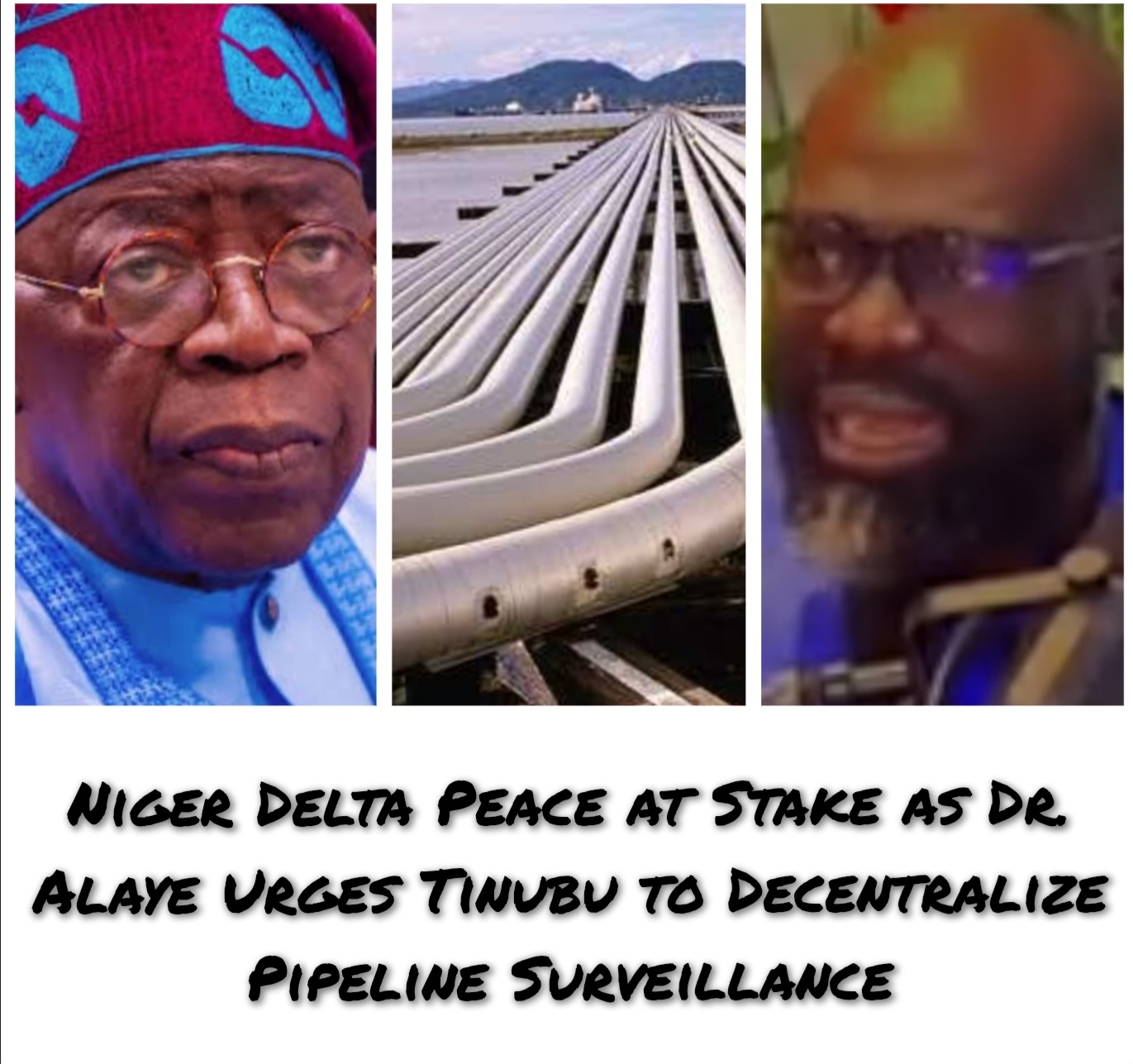
Dr. Alaye Theophilus has warned that the continued centralisation and alleged monopoly surrounding the pipeline surveillance contract in the Niger Delta could create fresh tensions in the oil-rich region, urging the Presidency and President Bola Ahmed Tinubu to urgently decentralise the arrangement in the interest of peace, accountability and increased crude oil production.
Speaking on the development, Dr. Alaye said the situation must not be allowed to degenerate into another crisis, stressing that the youths and host communities of the Niger Delta would ultimately bear the consequences of any conflict arising from the controversy.
“If this still gets to the next level, believe you me, there will be war in the Niger Delta. 2.1 million Naira in one family, trying to now make every other person sleep. No! My interest is to see how there will be peace in the Niger Delta,” he said.
According to him, the Niger Delta has a long history of conflict and is home to leaders and stakeholders who have been battle-tested through years of struggle in the region.
“Among war, leaders that have been battle-tested. And so many persons are believing that this is a joke,” Dr. Alaye stated.
He questioned the wisdom behind maintaining a centralised structure when prominent Niger Delta leaders have repeatedly advocated for the decentralisation of the pipeline surveillance contract.
“How can you tell me that Boyloaf is telling you that the pipeline surveillance contract should be decentralized? If Shoot Aside is telling you that the pipeline surveillance contract should be decentralized? If Ateke is telling you that the pipeline surveillance contract should be decentralized? If Asare is saying same thing? That is going to be some form of problem and you are telling me that Ateke it is not?” he asked.
Dr. Alaye stressed that any crisis in the Niger Delta would have its greatest impact on the youths and ordinary people of the region.
“If there is crisis in the Niger Delta, it is we the youths that will suffer it,” he said.
He also questioned claims that the existing arrangement was based purely on competence, asking how such competence was determined and where the assessment was conducted.
“That is why when people keep on saying that it is because of competence, you begin to wonder, whose competence? Where was that test carried out? Why these calls were made?” he queried.
He recalled the political circumstances surrounding the emergence of the pipeline surveillance arrangement, particularly the strained relationship between the late President Muhammadu Buhari's administration and Government Ekpemupolo, popularly known as Tompolo.
According to him, Tompolo was initially left out because of his strained relationship with the former President, while other prominent Niger Delta figures, including Shoot Aside and Boyloaf, were approached for the job.
“But Shoot Aside and Boyloaf, in their magnanimity, tried to see how Tompolo and Buhari can reconcile and make peace. Directed them to contact Tompolo, direct, so that when that job is given to him, they can have peace with Buhari and all his sins can be forgiven. All the alleged offenses that he has committed can be forgiven,” he said.
Dr. Alaye maintained that the original understanding was that the pipeline surveillance arrangement would be decentralised across the Niger Delta states, with relevant leaders and stakeholders playing roles within their respective areas rather than concentrating the entire responsibility in one structure.
“And that is how this job came. And when this job came, clear statements, declarations were made that this job are going to be decemtralize according to states, to leaders, not to be made coordinators,” he stated.
He accused some individuals of pursuing personal interests at the expense of the wider Niger Delta, arguing that the struggle for control and resources could create unnecessary tension among stakeholders.
“Conflict is a virtue and majority of our youth wants that. They want to live like commissioners. They want to live like governors at the expense of other people,” he said.
He further alleged that some individuals were moving from one office to another seeking financial support while backing arrangements that, in his view, could expose the entire region to another cycle of instability.
“And that is why you see, without going anywhere, they will go to Mr. A office, give us also money, we are going to support you,” he said.
Against this backdrop, Dr. Alaye called on President Bola Ahmed Tinubu and the Presidency to urgently review the structure of the pipeline surveillance contract and decentralise it across the Niger Delta states.
He appealed to the Federal Government to give state stakeholders and genuine host communities a greater role in securing and protecting oil infrastructure within their respective territories, arguing that those who live in the communities are better positioned to understand the local terrain, identify emerging threats and protect critical oil assets.
Dr. Alaye said the monopoly system should be dismantled for the sake of efficiency, accountability and improved security, insisting that decentralisation should not be viewed as a political concession but as a practical strategy for strengthening oil production and protecting national revenue.
He argued that a transparent, state-by-state and community-inclusive pipeline surveillance structure would encourage greater accountability, create a sense of ownership among host communities and reduce the possibility of conflict over the control of surveillance contracts.
He further maintained that improved security of oil infrastructure could help the country significantly increase crude oil output, with the ultimate objective of pushing production beyond 2.5 million barrels per day.
“For the wrong thing you are doing that you know that has what it takes to put the entire Niger Delta into another battlefield. If this thing get to the next level, believe you me, there will be war in the Niger Delta. That means oil facilities are going to suffer,” Dr. Alaye warned.
He therefore urged President Tinubu to act swiftly before the disagreement over the pipeline surveillance arrangement escalates, stressing that the overriding objective should be peace in the Niger Delta, protection of oil infrastructure, greater accountability and a sustainable increase in Nigeria's crude oil production.











0 Comment(s)